- Home
- About Us
- Membership
- Events
- Conference
- Sponsors
- Resource Center
|
Welcome to the SoCalCGP Newsletter. The newsletter provides links to this page. Please see below for the items that appeared in the October 2026 issue.
Charitable Gift Planning in 2026: Key Federal and California Developments New federal deduction rules and California legislation create planning considerations for charitable deductions, beneficiary designations, nonprofit qualification and estate planning. Federal tax changes and several California measures are worth noting for charitable gift planning in 2026. The most consequential developments concern the economics of the charitable deduction and the mechanics of completing charitable transfers. OBBBA Changes the Charitable Deduction Landscape The One Big Beautiful Bill Act, or OBBBA, significantly changes the federal charitable deduction beginning in 2026. Individuals who itemize are subject to a new 0.5% floor based on their contribution base, (generally adjusted gross income). Aggregate charitable contributions are deductible only to the extent they exceed that floor. Existing percentage limitations based on the contributed property and recipient generally remain, while the 60% contribution-base limitation for qualifying cash contributions to public charities has been made permanent. OBBBA also limits the tax benefit of itemized deductions for taxpayers in the highest marginal bracket, generally reducing the maximum federal income-tax benefit from 37% to 35%. Corporations are subject to a new 1% floor on charitable contributions while remaining subject to the 10% ceiling. Non-itemizers may deduct up to $1,000 for single filers and $2,000 for married taxpayers filing jointly for qualifying cash contributions. Contributions to donor-advised funds, supporting organizations and most private nonoperating foundations are excluded. Practice point: The new individual floor makes timing more important. For donors with significant multiyear giving plans, advisors should model whether concentrating contributions in selected years may produce a better result than level annual giving. Applicable percentage limitations and the differing treatment of charitable recipients must also be considered. SB 1288: Facilitating Charitable Beneficiary Transfers For planned giving, SB 1288 is one of the most noteworthy California developments. The measure passed the Legislature and was presented to the Governor on August 30, 2026. The bill addresses nonprobate transfers of securities when a nonprofit corporation, charitable trust or tax-exempt organization is named as beneficiary. It establishes procedures for beneficiary notification and specifies documentation charitable beneficiaries may provide to demonstrate their identity and entitlement to securities. Its provisions applicable to charitable beneficiaries were scheduled to become operative January 1, 2027, subject to enactment. Practice point: When using transfer-on-death securities registrations, advisors should confirm the charity’s correct legal name and organizational identity and coordinate the designation with the donor’s broader estate plan. Naming a charity does not, by itself, ensure an easy transfer after death. AB 2084: California and Federal Exempt Status AB 2084, presented to the Governor on August 27, would allow the California Franchise Tax Board, under specified circumstances, to retain an organization’s California tax-exempt status following suspension or revocation of its federal exemption. That discretion would not apply in certain circumstances involving fraud, intentional misrepresentation, misuse or diversion of funds, filing failures, or significant reporting or governance violations. For gift planners, California exempt status would not necessarily establish eligibility for a federal charitable contribution deduction. Federal qualification should be confirmed separately. AB 2221: Charitable Fundraising Platforms AB 2221, presented to the Governor on September 10, modifies California’s regulation of charitable fundraising platforms and the framework used to determine whether recipient organizations are in good standing. Among its provisions, the enrolled bill removes IRS-published lists from those upon which platforms may rely when making that determination. The measure primarily concerns platform compliance. A platform’s good-standing determination should not be confused with the separate federal analysis of whether a contribution qualifies for a charitable deduction. Related California Estate-Planning Measures AB 2199, signed June 30, updates California’s statutory power-of-attorney form, including options for appointing successor agents and granting authority over digital assets and electronic communications. The revisions may be relevant when philanthropic planning must continue during incapacity. AB 2658 would clarify a spouse’s ability to transfer that spouse’s one-half interest in specified community and quasi-community property to a trust for disposition at death. The transferred interest would remain community property unless the spouses agreed otherwise in writing. The latest information reviewed reflects referral to the Assembly Judiciary Committee on April 13, 2026, so its subsequent status should be confirmed before publication. AB 2090, signed July 13, increases the financial thresholds under which certain guardians and conservators may be excused from otherwise-required accounting. Its charitable-planning relevance is limited but may arise when planning intersects with fiduciary administration. Looking Ahead OBBBA is the principal development gift planners should understand, because it directly affects the timing and potential tax benefit of charitable contributions. In California, SB 1288 deserves particular attention because it addresses the practical completion of charitable beneficiary transfers. Together, these developments reinforce a broader point: effective charitable planning extends beyond calculating a deduction. Recipient qualification, contribution timing, beneficiary designations, transfer mechanics and coordination with the donor’s estate plan can determine whether a charitable strategy works as intended. Legislative status is based on sources reviewed through September 22, 2026. The current status, final text and operative dates of pending measures should be confirmed before publication. This article is for informational purposes only and is not intended as legal or tax advice. Why Commercial Annuity Buyers Deserve Attention in CGA Programs This article was provided by Stelter, a SoCalCGP Sponsor. By Nathan Stelter Think about a donor who cares deeply about your organization and is approaching retirement. They want to keep supporting your mission, but they're also wondering how to make their income last. So, they meet with an advisor, explore their options and purchase a commercial annuity. Was a charitable gift annuity part of that conversation? New research from TIAA Kaspick and The Stelter Company suggests that, for many of the people surveyed, it wasn't. That's an opportunity worth paying attention to. We may be missing a chance to help donors connect two things that already matter to them: dependable income and the causes they care about. Why we wanted to understand annuity buyers The question behind this research was a practical one. People are already committing assets to create lifetime income, in fact the Single Premium Immediate Annuity market, or SPIAs, accounted for more than $14 billion dollars last year. How much does this audience know about CGAs, and would they consider one if someone introduced it while they were weighing their options? To find out, TIAA Kaspick and The Stelter Company commissioned NAPCO Research to survey 1,010 American adults ages 60 to 85, in early 2026. Each had purchased a SPIA within the previous five years using assets outside of a retirement account. The findings appear in the new report Hidden in Plain Sight, you can download for FREE here https://www.stelter.com/cga-research. There was good reason to look at this audience. Both SPIAs and CGAs involve committing assets in exchange for lifetime payouts. A CGA also supports a charitable organization. By learning how commercial annuity buyers make decisions, we can better understand where a charitable option might fit. These are people who already give One finding deserves particular attention: 97% of respondents reported charitable giving, and 65% gave multiple times per year. Philanthropy was already part of their lives. They also had clear financial priorities: 86% rated securing guaranteed income for life as extremely or very important in their SPIA decision, financial strength and credibility of the provider mattered to 79%, and simplicity and clarity mattered to 78%. For gift officers, that gives us something useful to listen for. Along with a donor's connection to our mission, we should be paying attention to their retirement plans and income concerns. Someone who hasn't asked about planned giving may still welcome a conversation about how a CGA could support both their financial and charitable goals. Of course, purchasing a commercial annuity doesn't automatically make someone a suitable CGA donor. But the overlap is strong enough to deserve our attention. Many had never heard of the charitable option A staggering 42% of respondents were unaware of CGAs when they purchased their SPIA. Among that group, 76% said they would have considered a CGA if it had been introduced during their decision process. That's a meaningful finding. It suggests that some potential donors made an important financial decision without hearing about an option that might have appealed to them. We should be careful with what that number tells us. Saying you would have considered a CGA isn't the same as establishing one. The opportunity is to open more informed conversations, then learn how many lead to illustrations and completed gifts. The conversation needs to happen early Timing is a central theme in the report. Of respondents, 28% identified early retirement planning or first exploring annuities as the point when they would be most open to learning about CGAs. That gives us a reason to explore when our own outreach is happening. Do donors hear about CGAs while they're thinking through retirement income, or only after they've made their decisions? An earlier conversation can begin simply: "As you think about retirement, are you exploring ways to create dependable income? If so, would it be helpful to look at an option that also supports a cause you care about?" Questions like that can help uncover a need without assuming a CGA is the answer. Annual giving and major gift colleagues can listen for these planning conversations, too, and connect interested donors with planned giving staff. Someone who already owns a SPIA may have other assets or future planning needs. Still, this research gives us a clear reason to reach people before the assets they're considering have been committed. Bring trusted advisors into the conversation A significant portion of respondents (74%) said a trusted advisor recommendation would be extremely or very influential in their decision to consider a CGA. Among those aware of CGAs, 45% identified a trusted advisor, planner or attorney as a source of first awareness. For nonprofits, advisor relationships can help put CGAs into the conversation when they're relevant. A financial advisor, accountant or estate attorney needs an explanation they can use, an easy way to request an illustration and someone who can answer questions promptly. The study found differences in awareness across advisor types, although some of those groups were small. Those findings offer ideas for outreach rather than proof that one type of advisor is always more effective. Building relationships across disciplines and tracking the conversations they generate is a sensible place to start. Give donors room to ask the financial questions Even donors who love your mission need to feel comfortable with the financial arrangement. Among respondents who hadn't established a CGA, 42% cited concern about nonprofit financial stability, 39% cited lower payouts than a SPIA, and 37% cited complexity or unclear terms. Those are reasonable questions, and our communications should answer them directly. Explain how payouts work. Share relevant information about your organization's financial strength and annuity administration. Be clear about payout differences and what the charitable gift accomplishes. The report found that 43% expressed preference for, or openness to, a hypothetical option offering slightly lower income along with charitable impact. That suggests some people see value in that combination. Each donor still needs to decide whether the tradeoff works for them. A clear illustration, with its assumptions explained, gives donors and their advisors something concrete to discuss. It also gives us a chance to understand what matters most to that individual. What to take back to your program Start by looking at your outreach through a donor's eyes. Is it easy to see how a CGA might relate to their retirement plans? Do your materials answer the questions someone would ask before committing assets? Five practical takeaways emerge from the research:
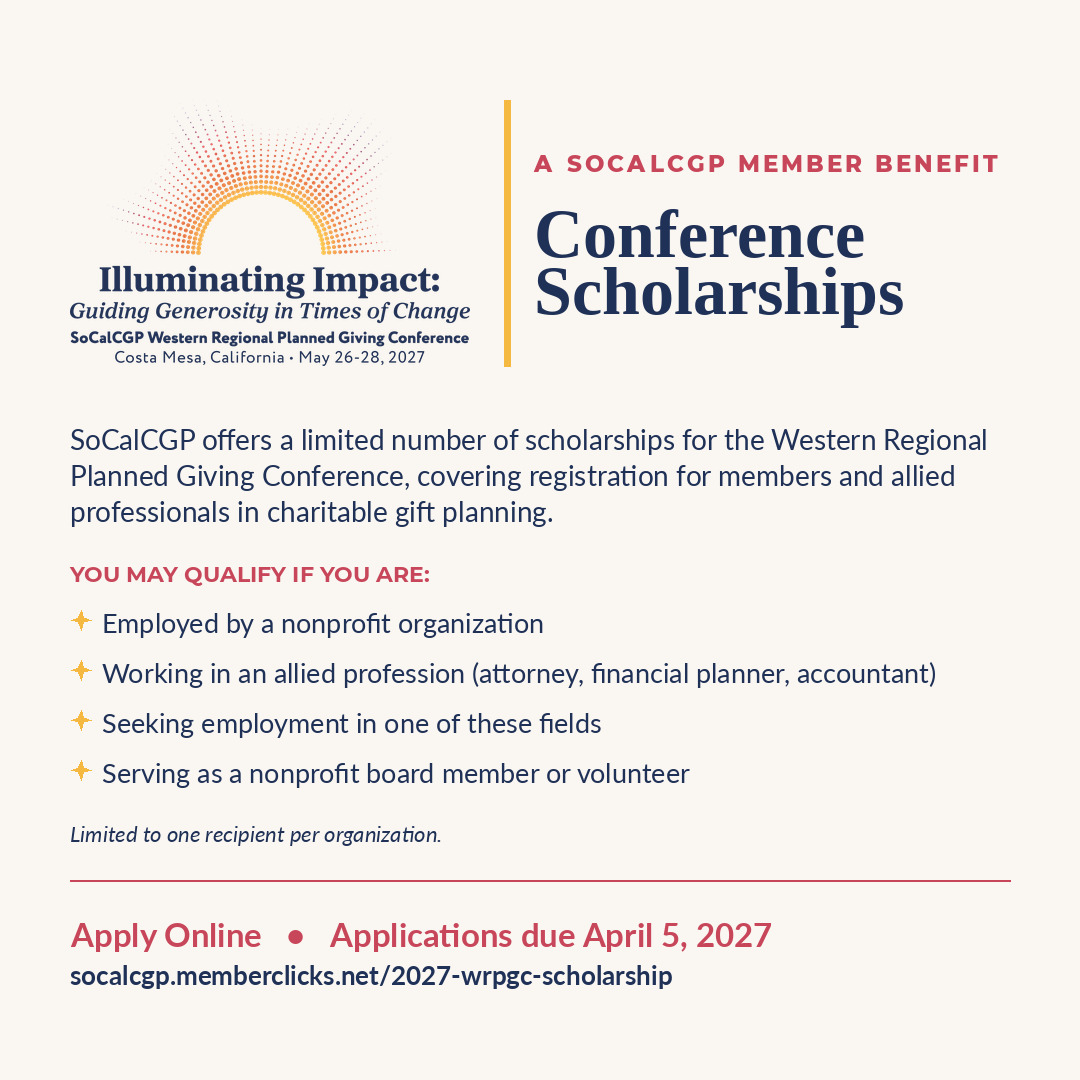
The opportunity here is to help more donors see a connection they may not have made on their own. When someone is thinking about income for the years ahead, a timely conversation about a CGA could also help them shape the legacy they want to leave. WRPGC 2027: Call for Conference Scholarships & Session Proposals
Member Profile - Liliane Ribeiro Liliane Ribeiro is the Director of Development for the Pasadena Symphony and POPS. She was born in Montreal, Canada, and spent time living in Hawaii, but Pasadena is now her home. Liliane is a new season pass member of SoCalCGP. "I have spent my career in the arts and academia, where I focused on major gifts. I also serve on the board of Vox Femina. Being well-versed in the latest charitable gift planning trends is essential to being an effective fundraiser, and so it was an enriching experience to attend the conference. I appreciate the new connections made and for the inspiration of ways to best promote planned giving to our supporters. SoCalCGP is such a warm and welcoming community of people dedicated to elevating philanthropy--thank you, SoCalCGP!" |